
For Jehovah’s Witnesses, the name “Jehovah” isn’t just a name—it’s everything. It’s a word of power, the key to a personal relationship with God, and a badge of exclusivity that separates his “true followers” from the rest of the world.
They teach that most religions hide or ignore God’s real name, but as God’s chosen organization on Earth, Watchtower has restored it.
Except there’s a little problem:
- “Jehovah” is almost certainly not the original Hebrew form of God’s name found in the Bible manuscripts.
- It’s best understood as a translation mistake from the medieval period (often dated around the 13th century), when Christian scholars misread Jewish scribal vowel marks.
- Most mainstream Bible scholars argue that the deity later called YHWH likely began as a regional war-and-storm god in the southern Levant before becoming identified as the sole God of Israel.
Let’s break it down—where “Jehovah” really came from, who YHWH actually was, and why this matters for exJWs (and anyone searching for the truth).
About the Bible Translations
For accuracy, all biblical references in this article come from the New Revised Standard Version (NRSV) unless otherwise noted. The NRSV is widely recognized among scholars as one of the most accurate and neutral translations, based on the best available manuscripts, including the Dead Sea Scrolls. The idea is to minimize doctrinal bias.
For comparison, the New World Translation (NWT)—the version produced by Jehovah’s Witnesses—has been modified in ways that reinforce Watchtower doctrine, sometimes altering the original meaning.
Is God’s Name Jehovah?
Short answer: No. “Jehovah” is most likely a late-medieval hybrid rendering of the divine name YHWH, taking shape around the Middle Ages (often dated to about the 13th century) when Christian scholars misread Jewish scribal vowel marks.
Where Did “Jehovah” Come From?
- The Original Name: YHWH – In the Hebrew Bible, God’s name is written as יהוה (YHWH), known as the Tetragrammaton (Greek for “four letters”).
- Jews Stopped Speaking It – Over time, many Jews stopped saying YHWH out loud, considering it too sacred. Instead, they usually said “Adonai” (meaning “Lord”) in its place, especially in public reading.
- A Translation Mistake – When Jewish scribes known as the Masoretes added vowel markings to preserve pronunciation, they put the vowels for Adonai under YHWH to remind readers not to say it aloud.
- Christian Scholars Misread It – In the late medieval period, Christian scholars didn’t realize the vowels were a reading cue and combined the vowels for Adonai with the consonants YHWH, producing ‘Yehovah,’ which later became ‘Jehovah’ in English.
“Jehovah” Is a Mashup of Two Separate Words
- YHWH (the original Hebrew name for God)
- Adonai (the substitute word meaning “Lord”)
📖 References:
- Britannica: “Jehovah”
- Tigay, Jeffrey H. Empirical Models for Biblical Criticism. University of Pennsylvania Press, 1986.
- Apologetics Press: Where Did ‘Jehovah’ Come From?
- GotQuestions.org: Is Jehovah the True Name of God?
Bottom line?
- By the late Second Temple period, many Jews no longer pronounced the divine name out loud; earlier Israelites almost certainly did.
- “Jehovah” is a mistake made by later scholars who misunderstood Jewish scribal traditions about how the name should be read.
- If you really want to use God’s original name, “Yahweh” is probably closer—but even that’s a scholarly reconstruction. Any pronunciation we use today is a best-guess based on available evidence.
Who Was YHWH Before He Became “Jehovah”?
Turns out, he wasn’t always the one true God.
Early Israelite and Judean religion was not neatly monotheistic. Evidence from archaeology, inscriptions, and the Bible itself suggests that many Israelites practiced something closer to polytheism or henotheism—worshiping YHWH as their main god while also acknowledging other deities in a larger divine family under El.
Over time, especially in the exilic and post‑exilic period, Israel’s theology moved toward the strict monotheism you see most clearly in parts of Isaiah, where YHWH is described as the only true God.
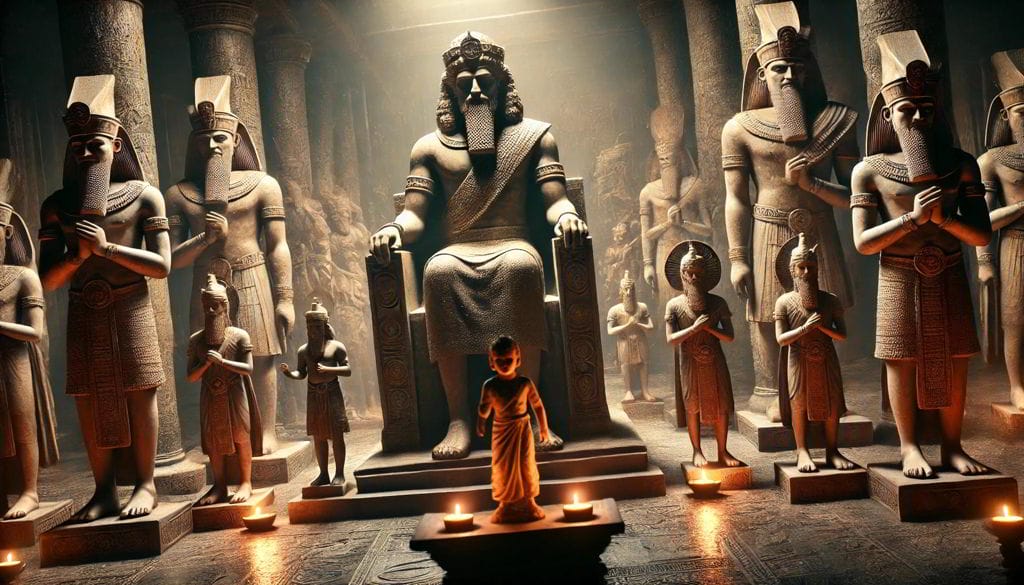
YHWH: The War and Storm God
Long before anyone said “Jehovah,” the deity behind the name YHWH had a history. Most mainstream scholars think he likely began as a local war‑ or storm‑type god in the southern regions around Israel (places like Edom or Midian) and only later came to be identified as the one God of Israel.
Evidence YHWH Was a War God
In some of the oldest biblical text, YHWH shows up as a divine warrior whose power appears in storm‑language—thunder, lightning, earthquake, and torrents of rain, marching from places like Seir and Edom.
- Exodus 15:3 – “YHWH is a warrior; YHWH is his name.”
- Judges 5:4-5 – “YHWH came from Edom… the earth trembled, the heavens poured, the clouds indeed poured water. The mountains quaked before YHWH, the One of Sinai, before YHWH, the God of Israel.”
- Many Canaanite and Mesopotamian storm gods, like Baal and Hadad, had similar traits—controlling the weather, leading armies, and demanding absolute loyalty.
📖 References:
- Smith, Mark S. The Early History of God: Yahweh and the Other Deities in Ancient Israel. Eerdmans, 2002.
- Cross, Frank Moore. Canaanite Myth and Hebrew Epic. Harvard University Press, 1973.
- Minerva Wisdom: How Yahweh Became God: The War God Thesis
- Big Think: How Yahweh Became ‘God Almighty’

If “Jehovah” Isn’t God’s Name, Then What?
For Jehovah’s Witnesses, the name “Jehovah” isn’t just a name—it’s a lifeline. Watchtower drills it into members as a sacred shield:
- Use it constantly in speech and prayer.
- Invoke it in times of danger—because it purportedly drives away Satan and demons.
- Repeat it to demonstrate spirituality and loyalty—because true worshippers must “sanctify God’s name.”
That’s why questioning it feels like the ultimate betrayal.
But “Jehovah” was never the original Hebrew form of God’s name. So it was never sacred. It’s a medieval mistake that Watchtower repackaged as divine truth. You’re not betraying “Jehovah” by leaving. You’re walking away from a linguistic error.
Once you stop using (and venerating) the name, the automatic responses it triggers—fear, obligation, and guilt—can begin to fade. The word “Jehovah” has been drilled into your brain as a symbol of safety and obedience, but with the facts, you can start to see it for what it really is: just a made-up word.
None of this is based on secret, insider knowledge or ‘apostate lies.’ It’s what you find from researching Hebrew manuscripts, history and mainstream biblical scholarship instead of restricting yourself to Watchtower publications.
If you do believe, let that belief be built solidly upon knowledge, and not a made-up word.
📜 Please note: While I aspire to complete accuracy, I’m not a Bible scholar (and I don’t play one in a cult). If you find any factual errors, please contact me and provide references. And thanks.