
It hits at 2 a.m. You’ve walked away. You’ve pulled apart the doctrine. You’ve counted the failed prophecies: 1874, 1914, 1925, 1975—on and on, always ending with a vague “any minute now.” You know it’s a scam.
And still the question lingers—what if I’m wrong?
That dread? That guilt? It’s not spiritual insight. It’s a psychological tripwire—Watchtower’s final defense, buried deep and set to go off the moment you start to feel safe on the outside.
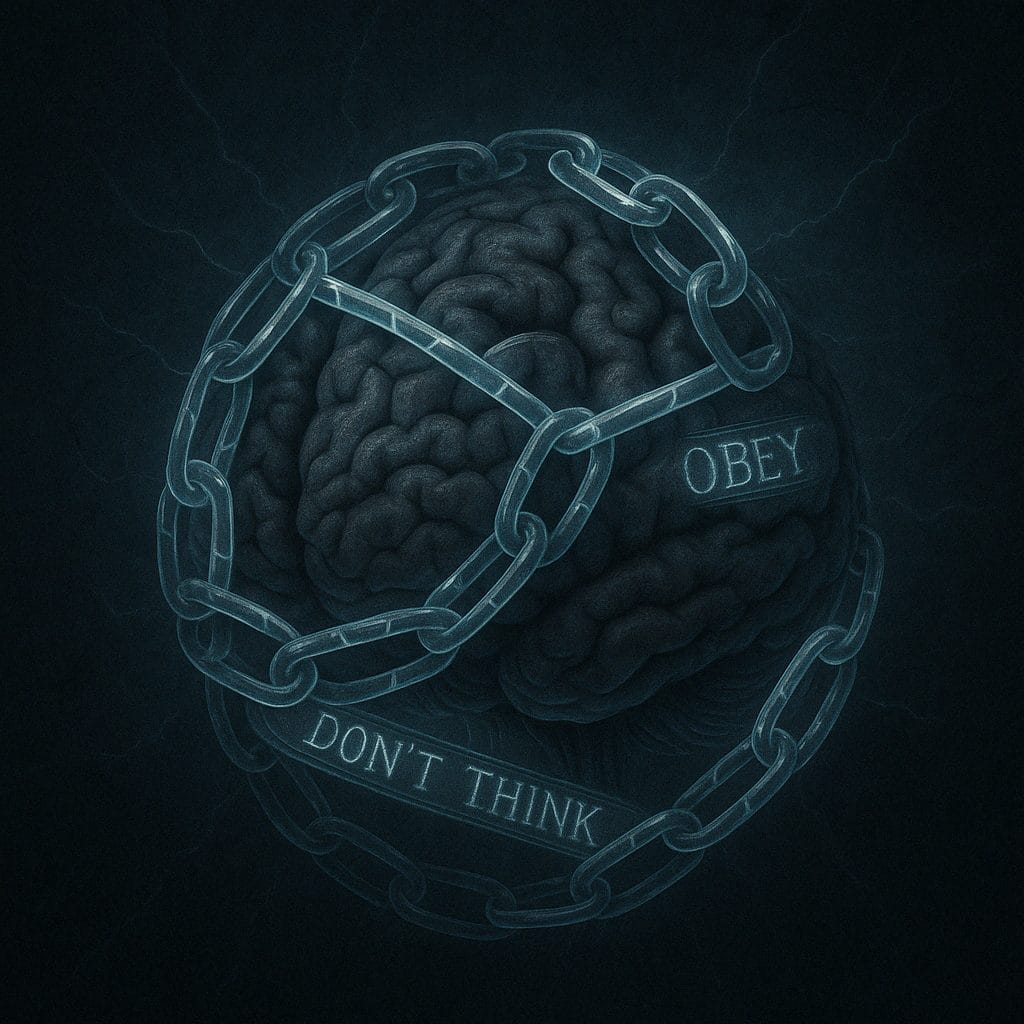
Jehovah’s Witnesses don’t just give you beliefs. They install alarms in your brain. Obey, and you’re “safe.” Question them, and the fear kicks in. You start mistaking conditioning for conscience.
But that voice in your head? The one whispering that doubt equals danger? It isn’t yours. It was planted.
When Doubt’s a Trap, Not Truth
High-control groups like Jehovah’s Witnesses don’t just promote specific beliefs—they reshape how you think and feel about those beliefs. They train you to override your own gut and hand over your judgment to them. It’s not just faith—it’s identity engineering.
Margaret Singer put it this way:
“Today’s programs are designed to destabilize an individual’s sense of self by undermining his or her basic consciousness, reality awareness, beliefs and worldview, emotional control and defense mechanisms. This attack on a person’s central stability, of self-concept, and on a person’s capacity for self-evaluation is the principal technique that makes newer program work.” — Margaret Thaler Singer, Cults in Our Midst, (1995) p. 60
Robert Jay Lifton called it “mystical manipulation”—every bit of favorable coincidence is divine approval, every setback is Satan’s work, and every doubt is treason against God himself. Sound familiar?
That’s why it feels so wrong. It was designed to.

Obedience Over Instinct: Watchtower’s Self-Doubt Toolkit
The Organization has a phrase for every emotion that might pull you toward independence. But none of them are meant to guide you to self-empowerment—they’re there to shut your autonomy down.
- “The heart is treacherous.” Don’t trust your gut—only them.
- “Lean not on your own understanding.” You’re too flawed to think straight.
- “Independent thinking is dangerous.” Thinking for yourself is rebellion.
- “Satan blinds the mind.” Confusion means you’re already in danger.
- “Obey even if it doesn’t make sense.” Doubt = disloyalty.
- “Wait on Jehovah.” Let the Governing Body rewrite reality on their schedule.
- “The light gets brighter.” Their mistakes are your lack of faith.
- “The Governing Body speaks for Jehovah.” Questioning them is questioning God.
- “Obey the faithful slave.” Keep shoveling—don’t ask where the train’s headed.
- “Trust the elders.” Even over your own experience.
- “Meekness is obedience.” Submit. Stay quiet.
- “Feed your faith, starve your doubts.” Think less, obey more.
- “Faith means submission.” Kill your own ideas—call it devotion.
- “Don’t run ahead of the chariot.” If you noticed the problem, you’re the problem.
- “Spiritually weak.” Doubt is your personal failure.
- “Wisdom of this world is foolishness.” Science, conscience, therapy—irrelevant.
- “Apostates twist the truth.” Outside sources can’t be trusted.
- “Loyalty is obedience.” Love is meaningless if you don’t submit.
- “Questioning breaks unity.” Speak up, and you’re out.
Why the Fear Still Grips You
Those phrases weren’t just overused words—repeated often enough, they do a rewiring job on your brain. Cult experts spell it out:
- Steven Hassan’s BITE Model (Combatting Cult Mind Control, 1988) explains how Thought Control (“feed your faith, starve your doubts”) and Emotion Control (wanting to make your own decisions is shameful and selfish) make questioning the Governing Body’s authority feel like sin.
- Albert Biderman’s Chart of Coercion (1957) shows how suppressing dissent and enforcing unity create a monopoly on perception—when disagreement is eliminated, an illusion of consensus makes doubters question themselves instead of the evidence.
- Leon Festinger’s Cognitive Dissonance Theory (A Theory of Cognitive Dissonance, 1957) explains why conflicting realities (“They’re wrong” vs. “They’re speaking for God”) trap people in place—obedience feels easier and less painful than facing the possibility that the group itself is wrong and all the implications that go with it.
- Swann’s Identity Fusion Model (Swann et al., 2012, Psychological Science) describes how merging personal and group identity makes separation feel like self-loss—the ‘new personality’ demanded by the group means leaving isn’t just exiting a faith but losing your identity itself.
That’s not faith. That’s carefully engineered captivity.
Breaking Their Hold
That 2 a.m. question—’What if I’m wrong?‘—isn’t spiritual warning. It’s a cult defense mechanism doing its job. When you feel it, remember:
- “Treacherous heart”? That’s code for “Don’t trust yourself.”
- “Obey even if it doesn’t make sense”? Translation: “Leave the thinking to us.”
- “Loyalty is obedience”? What they mean is: “Making your own choice is betrayal.”
These ideas didn’t come from God. They came from a publishing/real estate empire run by a club of men who never admit they’re wrong unless forced to. And even then, they aren’t going to apologize.
You’re not betraying God. You’re walking away from a fraud. Your doubts aren’t weakness—they’re strength.
They’re also your first step out of the fog.

Books About Cult Control
While there are many great books on cultic control, here are a few that touch on topics discussed here.
- Cults in Our Midst – Margaret Singer
- Thought Reform and the Psychology of Totalism – Robert Jay Lifton
- Combatting Cult Mind Control – Steven Hassan