
It’s been months, years, or even decades since you got out. You’ve cried, ranted, raved, pondered, and processed every little thing that came your way. You’ve researched, read, maybe even prayed and therapized yourself ad infinitum in order to unpack your emotional baggage. You bravely faced it all.
“I’m finally over it,” you say to yourself with a sigh and a little smile, certain that this time, finally, you’ve got it licked! There’s nothing left to work out. You are finally at peace.
And this works great—maybe for a long time, even. But sooner or later, the right set of circumstances coalesce, and you find yourself neck-deep in a big sea of triggered.
If you’ve left the Jehovah’s Witnesses (or another cultic religion), this might hit especially hard. Maybe you run into an old JW acquaintance, or someone sends you a Watchtower article, and suddenly, your heart is racing, your mind is spinning, you start shaking and it feels like all your healing just disappeared in an instant.
First, Let’s Get One Thing Straight
It’s not your fault. You’re not doing anything wrong.
And just as important: The fact that it feels worse than ever is NOT because you did ‘healing’ wrong. It’s absolutely no indication of subpar emotional work. If anything, it proves how far you’ve come.

The Reality of Trauma: Why Religious PTSD Doesn’t Just Go Away
PTSD (Post-Traumatic Stress Disorder) and C-PTSD (Complex PTSD)—the long-term trauma response often seen in exJWs and former high-control group members—are not just psychological. They are nervous system responses that kick in when your brain perceives a threat.
When you were part of Jehovah’s Witnesses, or any controlling environment, your body learned to stay hypervigilant—watching for the next condemnation, guilt trip, or emotional manipulation. Even after you leave, your nervous system holds onto that programming.
Your brain doesn’t care that time has passed or that you’ve done the work—it just sees something familiar and flips the survival switch.
Fight, Flight, Freeze, or Fawn: What Your Nervous System is Doing
When you get triggered by something related to your past in a cult or abusive family (or both), your nervous system instantly kicks into survival mode, reacting based on learned trauma patterns. This isn’t something you consciously choose—it’s your body trying to protect you.
- Fight: Your sympathetic nervous system floods your body with adrenaline and cortisol. Your heart pounds, your muscles tense, and anger or frustration flares up. You might feel an overwhelming urge to push back, defend yourself, or lash out.
- Flight: The same rush of stress hormones hits, but instead of standing your ground, your brain decides escape is the safest option. You feel restless, anxious, panicky, or overwhelmed. Your thoughts race, and all you can think about is getting away as fast as possible.
- Freeze: Instead of gearing up for action, your parasympathetic nervous system slams the brakes. Your body shuts down, your mind goes foggy, and you might feel frozen, numb, or detached. Some people dissociate, struggling to register what’s happening around them. This is your brain playing dead to survive.
- Fawn: This response is rooted in the vagus nerve, which regulates your social and emotional safety. Instead of fighting or fleeing, your body defaults to appeasement. You feel an uncontrollable urge to people-please, smooth things over, or suppress your real feelings to avoid conflict. (This isn’t cowardice. It’s a deeply ingrained defense mechanism—especially for those who grew up in environments where upsetting the wrong person meant serious consequences.)
Why Triggers Can Feel Worse After Healing from Religious Trauma
This might sound counterintuitive but triggers often feel WORSE the longer you’ve been out. Why? Because you’ve actually healed enough to recognize the damage. This state is no longer the norm for you.
Think of it like this: If you stayed in a toxic, smoke-filled room every day, over time your body would adjust to the fumes. You still might not like it, but you wouldn’t notice how bad it really was anymore. But if you stepped outside into clean air for months or even years, and then suddenly walked back in? You’d choke immediately.
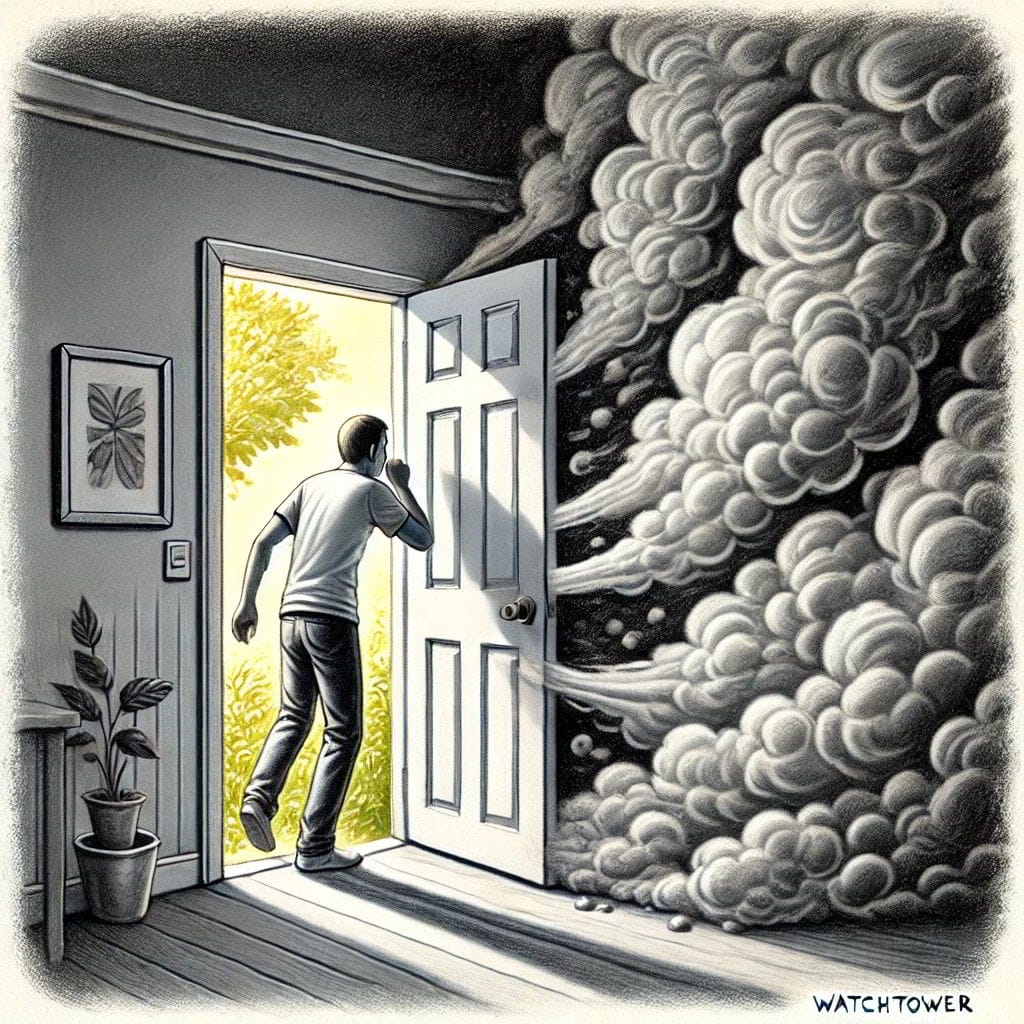
Same thing with trauma. When you were in the Jehovah’s Witnesses, or any high-control group, you had to navigate, adapt to and ultimately normalize a lot of very toxic behavior to survive. But once you leave and start healing, your body learns what safety feels like. You adjust to the fresh air of freedom.
So, when you get unexpectedly exposed to something from the past—like a JW family member guilt-tripping you, or someone mentioning “the Truth”—your nervous system rejects it, hard. Your body is screaming, ‘This is dangerous! Stay away!‘
So really, the fact that triggers are so much worse now is evidence of how far you’ve come! Essentially, you’ve developed an “emotional allergy” to toxic and abusive situations. Your body is rejecting what you no longer belong to. That’s not a bad thing and it’s certainly not a sign of weakness. It’s self-protection in action.
How to Cope with Religious Trauma Triggers
1. Remind yourself: This is a nervous system response, not reality.
Your body is reacting to past danger, but you are not in the past. Tell yourself: “This is just a trigger. I am safe now. This will pass.”
2. Get back to the present moment.
Ground yourself. Press your feet firmly into the floor. Touch your arm or the fabric of your clothes. Notice the temperature, sounds, or find a color to focus on nearby. Focusing on your senses—what you can see, hear, feel, or smell—helps return your brain to where and when you actually are.
3. Slow it down.
If your heart is racing, your hands are shaking and you’re spiraling—pause. Let yourself regulate. Move, stretch, slowly breathe in through the nose, out through the mouth—whatever feels grounding. Give yourself whatever time and space the situation allows.
4. Make a plan for handling triggers.
Not every trigger can be avoided, but knowing what tends to set you off helps. Ask yourself:
- Can I distance myself from this, even temporarily?
- If I can’t, how might I respond next time? Maybe it’s a mental script, a go-to coping method, or a phrase or strategy that buys you some time to recover.
- Do I need to limit certain types of exposure (social media, specific places, people)?
- What can I do immediately after a trigger to help myself feel stable and calm again?
5. Take care of yourself afterward.
Triggers drain your energy because your nervous system just went into overdrive. It’s both upsetting and physically taxing. Help yourself recover:
- Drink water and eat something nourishing—this helps your body regulate and grounds you.
- Engage in something comforting (music, nature, movement, journaling—whatever soothes you).
- Remind yourself this moment will pass. It always does.
- Reach out if you need to. You don’t have to process it alone. Friends, a therapist, or online support can help remind you of your current reality and understand what happened.

You’re Not Backsliding—You’re Living
Healing from religious trauma, Jehovah’s Witness indoctrination, or narcissistic abuse isn’t about never feeling triggered again. It’s about learning to recognize the patterns, navigate, and come out the other side faster and stronger.
Healing isn’t the same as never having been hurt. Healing means the hurts no longer run your life.
The fact that you’re noticing triggers more intensely now? That’s a sign that you’re not numb anymore. You’re alive. You’re aware. And you are choosing, every day, to step into a life that is fully yours.
And that? That’s real healing.